

CONFUSIONS AND CLARIFICATIONS: AN INTRODUCTION TO PHILOSOPHY FOR THE TWENTY-FIRST CENTURY, Lanham, MD; New York; Oxford: University Press of America, 1997. 8.5 x 5.5 inches. 287 pages.
Dedication: To my wife Helen Angela, and our three children, Helen, Paul Matthew, and Laura; and to my four sisters, Patricia, Jeanne, Gloria, and Angela, and their families, without whom my life would not be as complete as it is.
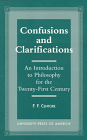
An Introduction to Philosophy for the Twenty-First Century
By F.F. Centore
This book brings together the chief elements of 3,000 years of philosophy in a highly readable form. The work concentrates on problems and issues much more than on names, dates, and places. It begins with just those elements of logic needed to understand what follows in the rest of the book. It then explains why philosophy is a worthwhile and distinctive branch of knowledge relative to the other main areas of intellectual interest. Next, it deals with the central problem in philosophy insofar as philosophy is a speculative study. And finally, it deals with the central issue in philosophy as a practical science, which is the art of managing one's affairs well. The book includes an extensive bibliography of works related to the main themes of the text, followed by a long list of the names and dates of the leading historical figures in various fields, especially science, philosophy, and theology.
December 1997 288 pages
ISBN 0-7618-0968-6 $25.50 paper (new price July 1998)
Contents

Preface


I A Little Light Logic


 	1.1 The subject area of logic

 	1.2 The proposition and its forms

 	1.3 The main forms of deductive reasoning

	1.4 Some common errors in deductive reasoning


II The Phenomenon of Philosophizing


 	2.1 The importance of proper definition

 	2.2 The different levels of learning

 	2.3 The practical and the speculative

 	2.4 Philosophizing and theology

 	2.5 The definition of philosophy


III The Saga of Essence and Existence


	3.1 The enigma of the one and the many

 	3.2 The four possible theories

		3.2.1 Nominalism

 		3.2.2 Conceptualism

 		3.2.3 Exaggerated Realism

 		3.2.4 Thomism

 	3.3 Our current cave culture

 	3.4 The physical and the spiritual


IV The Foundations of Morality


 	4.1 The meaning of the good

 	4.2 The anthropocentric model in ethics

 	4.3 The theocentric model in ethics


Bibliography

Some Names and Dates

Index